I love treating ethical money decisions as wicked problems
Money is tricky – and fascinating to me – because it shows up in many kinds of problems:
- a practical issue of resource management tactics,
- an ethical issue of values-aligned action [or misalignment],
- a social issue of fairness and inequality,
- an impact issue regarding resource extraction and the environment,
- a self-relationship issue of believing in your worthiness and competence,
- an autonomy issue of self-determination,
- an input and transparency issue when decisions about it impact us without our say,
- a political issue as related to what governments get, and spend it on,
- a labor issue in regards to wages vs profits, exploitation vs
- an economics issue of cost of services/goods,
- a cultural issue of consumerism and status,
- a moral issue as applied to use, sharing, and giving,
Every issue space has lots of people, with lots of opinions.
No one has a perfect answer for you or a roadmap that makes all the decisions for you.
No one has fully resolved the issues related to global resource management, personal ethics, labor economics, and market participation.
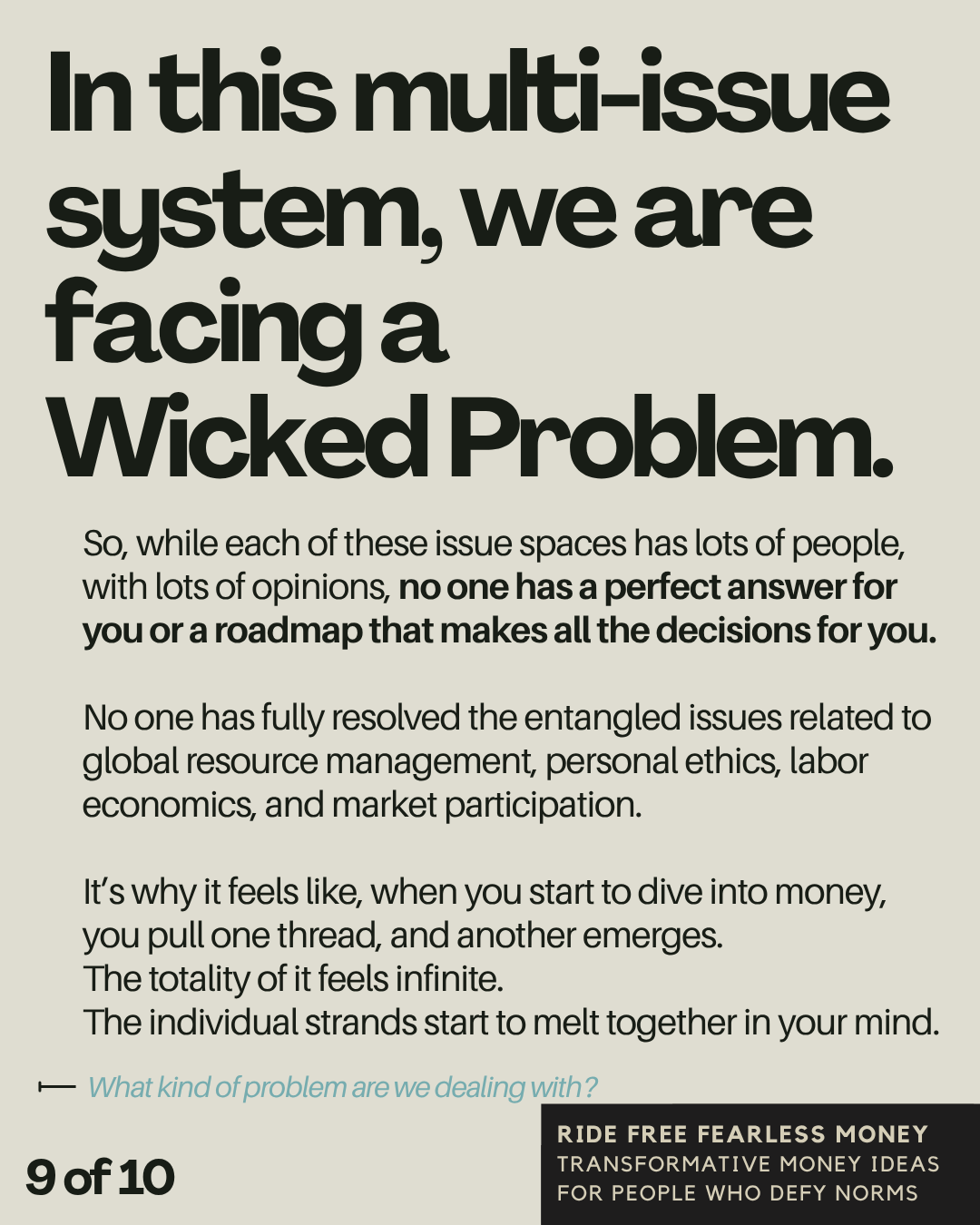
That’s because in the multi-issue system we’re in, we are facing what’s called a Wicked Problem.
Pull one thread of it, and another emerges.
The totality of it feels infinite.
The individual strands start to melt together in your mind.
And while you might have started just trying to figure out how to divide the rent with a partner, which car to get, what salary to ask for, or deal with a conflict because there’s not enough money for something important…
Every strand of every issue rears its head and the whole thing can get overwhelming.
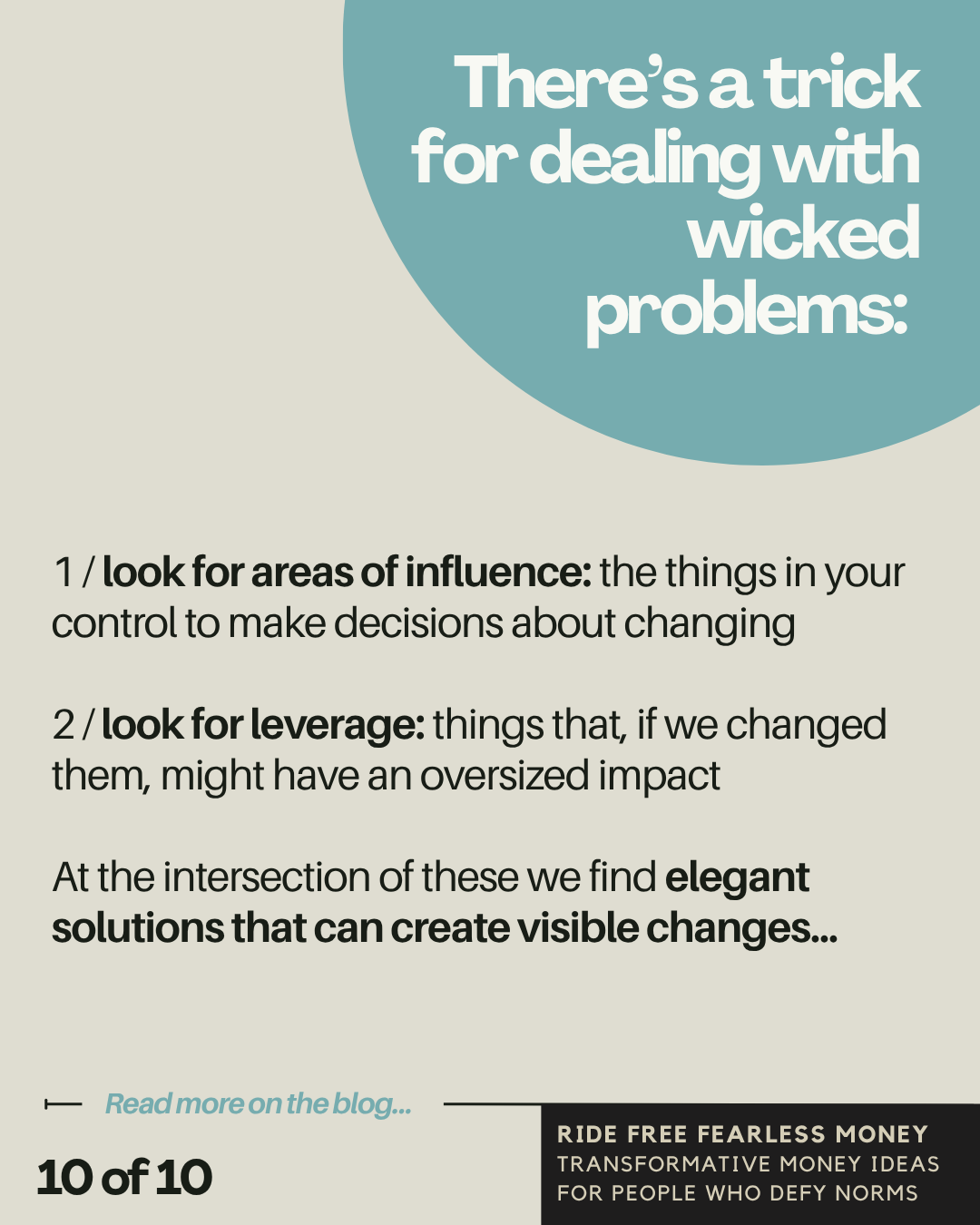
There’s a trick for dealing with wicked problems:
- 1 / look for areas of influence – the things in your control to make decisions about changing
- 2 / look for leverage – things that, if we changed them, might have an oversized impact
At the intersection of these – influence and leverage – we find elegant solutions that can create visible changes.
There’s several areas of influence when it comes to money.
Before you read this, I want to say: NO ONE DEALS WITH ALL OF THESE. YOU DO NOT HAVE TO MAKE DECISIONS ABOUT ALL OF THESE.
The point of this article is the opposite of feeling frozen in ethical overwhelm so I need to say that loud and clear.
With our personal finances [or businesses or nest eggs we have power in] YOU have to make decisions, when it comes to money.
- How you make, keep, and spend it.
- When you save or give it.
- What to invest in.
- How you’ll manage debt you may have.
- If you’ll participate in consumer culture, and how much.
- Which decisions you make alone and which you include others in.
- If you’re willing to expand or contract how you think about what money you need.
And there are ways we can design our lives to be more ethical when it comes to money
- Choosing used things,
- living collectively,
- sharing resources and money equitably,
- making money decisions democratically,
- supporting people who aren’t as resourced or privileged.
- Paying people who you buy from, or who work for you, living wages – even when it costs more
- Practicing transparency in the organizations we volunteer for and work in
- Everyday choices about the packaging and products we need on the regular
- Making choices about where to keep money, if there’s a lot of it you’re responsible for
But there are areas outside of the direct influence of most of us: state finances, federal policies, corporate entities, cultural norms.
There are still change decisions to be made here, though the impact of our actions is more diffuse:
- Not purchasing from certain companies [eg BDS]
- Not investing in certain types of businesses or parts of the market [eg choosing carbon-free, ESG or SRI investments]
- Not keeping our money in banks that fund war and oil [eg using a coop or community bank]
- Refusing to partake in consumerism, marketing hype, “keeping up” spending, and not buying new things.
- Reducing the amount of taxes you pay
- Who you vote for and creating political pressure on electeds
- Choosing non-participation [not taking student loans, under-earning to undercontribute]
Remember:
With all these problem and issue spaces at play, we can get overwhelmed trying to understand our approach… until we treat money as a Wicked Problem: one that requires us to look for specific leverage and discrete areas of control, instead of solving the WHOLE thing.